
The refreshed Data Strategy for Aotearoa NZ, commissioned by the Government Chief Data Steward and published by Stats NZ in September 2021.
Please note: the Roadmap has not been updated. Go to the PDF version to view the original Roadmap.
Government Data Strategy and Roadmap [PDF 1.32 MB]
Data has the power to improve our lives - by making Aotearoa NZ a better place to live, work, visit, and do business. From the Beehive to the whare, good data can help all New Zealanders make informed choices about the things that matter most in our homes, workplaces, and communities.
Today government agencies hold a vast amount of data about and on behalf of Aotearoa NZ. Information that has the potential to drive innovation, and contribute to social, environmental, and economic progress.
But we can only fully realise that value if we take a joined-up, strategic approach to the way data is collected, shared, and used. And we must never forget that everything we do with that data is underpinned by the trust and confidence of the public.
New Zealanders are right to demand their data is stored safely and used ethically. And they are right to expect government will take an efficient, value-minded approach to investment in new and emerging uses of data.
If we are to meet those expectations, we must continue to build and maintain an innovative, adaptable and robust government data system that will be up to the challenge. And that is what this refreshed strategy is all about.
In the wake of COVID-19, the world feels like rather a different place than it did in 2018, when the first data strategy was published. Recent events have only served to underline the necessity for an adaptive, responsive data system.
There are big challenges ahead. Challenges we can only meet with collective action.
Progress, more than anything else, will require collaboration. Collaboration across agencies, collaboration with Māori and iwi partners, and with a range of experts, specialists, and interested groups.
For many Māori, data is a taonga. In honouring Te Tiriti, we must work in genuine partnership with iwi and Māori, taking a consensus view on our direction of travel and pace of change.
Success is a data system that is both inclusive and integrated. A system where anyone who wants to base their decisions on credible information can do so with ease. A system that generates the deepest insights and the best services, at the least effort to the people and organisations behind the data.
As the COVID-19 pandemic has shown only too well, good decisions rest on good data. Looking to the future, it is our responsibility to ensure New Zealand is equipped to meet whatever challenges lie ahead on a bedrock of data-driven insights and analysis.
As the functional lead of the data system, my role is to encourage and enable a spirit of collective advancement. I believe our data system can be among the most effective and responsive in the world. And I believe this strategy puts us on course to make it happen.
Mark Sowden
Government Chief Data Steward
The Government Data Strategy provides a shared direction for Aotearoa NZ's government data system. The first Data Strategy and Roadmap was commissioned by the Government Chief Data Steward and published in 2018.
The first Data Strategy was published in 2018. Agencies worked hard to realise the ambitions of that strategy which were:
However, the data landscape is rapidly changing. Since the first Data Strategy and Roadmap was published, agencies have been working together on a 10-year Data Investment Plan. Stats NZ and Data Iwi Leaders Group have signed a Mana Ōrite Relationship Agreement to realise iwi data aspirations. A range of initiatives have been developed to increase trust in the data system, including the Data Protection and Use Policy and the Algorithm Charter for Aotearoa NZ. In addition, the COVID-19 pandemic has completely changed the context in which data is collected, managed, and used.
Despite the progress made between 2018 and 2021, there are some fundamental data system issues to be resolved:
Throughout the process of refreshing the strategy, key stakeholders from central and local government, business, community organisations and non-government organisations (NGOs) have participated in workshops, providing guidance and technical expertise. They have tested the strategy direction to ensure it is future focused, robust, practical, and able to be adapted to different data sources and uses.
Currently, a lack of integration between government services means New Zealanders may be required to provide the same information to multiple agencies in order to access services. There is limited visibility of what information agencies hold about New Zealanders and how it is used.
Where data is visible and usable, it can contain gaps. This makes it harder to access information or insights about important topics and communities. This lack of visibility and coverage, combined with current data system settings, also means the rights and interests of Māori and iwi are not realised.
The Government Data Strategy will give effect to the following objectives:
The Information Group is the key governance body for the Government Data Strategy. It is responsible for setting, implementing, monitoring, and reviewing the progress made against the strategy.
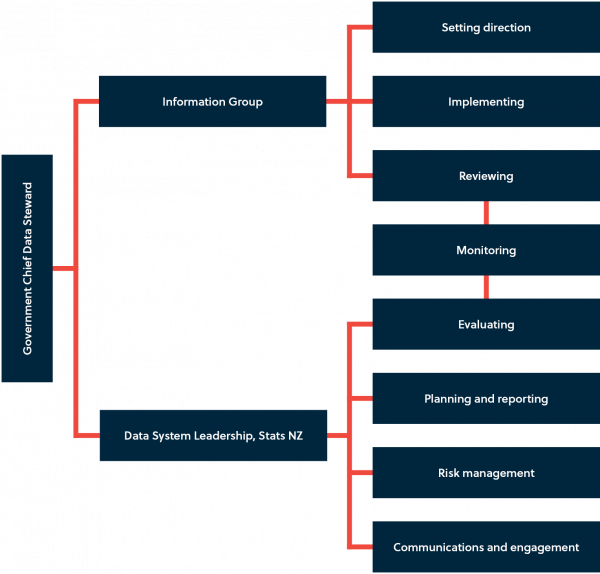
Fig 1. the governance roles of the Government Chief Data Steward, Information Group and Stats NZ.
The refreshed Government Data Strategy is designed to create an inclusive and integrated data system that supports innovation safely.
An inclusive data system means anyone who wants to access data to inform decision-making can do so in a way that works for them. Inclusivity ensures that the people of Aotearoa NZ see themselves reflected in the data the system produces.
An integrated data system creates maximum insight with minimum burden for providers of data. Standards, guidance and protocols ensure data can be found, managed, shared, combined, and re-used. An integrated data system means data can be shared easily while also protecting privacy, security, and confidentiality.
The Government Data Strategy will be brought to life through principles adapted from the Data Protection and Use Policy, the Mana Ōrite relationship agreement between Stats NZ and the Data Iwi Leaders Group, and the Public Service Act 2020.
Respect and uphold the mana and dignity of the people, whānau, communities, and groups who share their data and information.
Empower people by giving them a choice and enabling their access to, and the use of, their data and information.
A shared culture of respect, guardianship, care, and protection for data as a strategic and valued resource, recognising that for some Māori, Māori data is a taonga and iwi-Māori are kaitiaki over their taonga.
Leadership that focuses on common purpose whilst also respecting the autonomy and independence of individuals, groups and agencies.
Strong transparent relationships through respect, integrity, empathy, and commitment to the kaupapa.
The four fundamental components of an inclusive and integrated government data system are data, capability, infrastructure, and leadership. These are the focus areas of the Government Data Strategy.
The Government Data Strategy is underpinned by a responsibility to uphold Te Tiriti and a commitment to maintaining and enhancing Public Trust and Confidence.
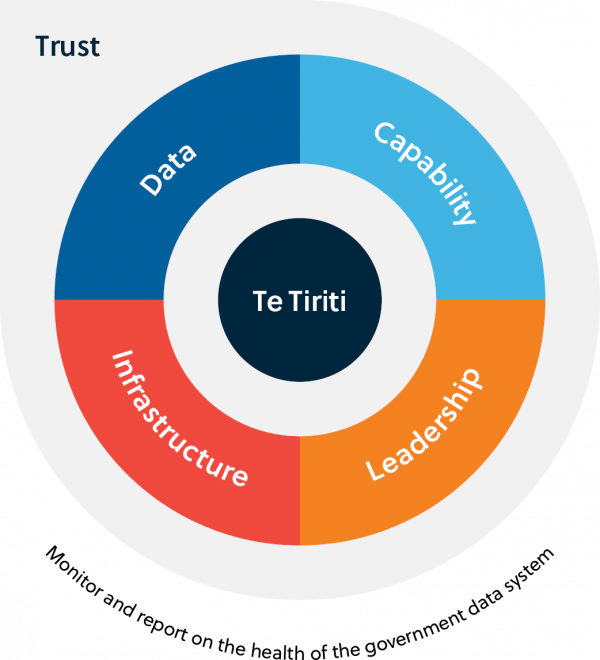
The Data System is committed to upholding the principles of Te Tiriti.
Authentic partnership with Māori and an understanding of Te Ao Māori will play a fundamental role in implementing the Strategy.
Public trust and confidence are fundamental to unlocking the value of data for all New Zealanders. The data system relies on a high trust environment, where the public enables agencies and organisations to use and share data for individual and collective benefit.
The Government Data Strategy is designed to build and maintain trust and confidence in the data system.
Provide the right data at the right time.
Develop capability and skills within our people to create, collect, manage, and use data.
Ensure leadership, clear rules, and system settings are in place and are well understood.
Build the infrastructure that enables effective data management and reuse.
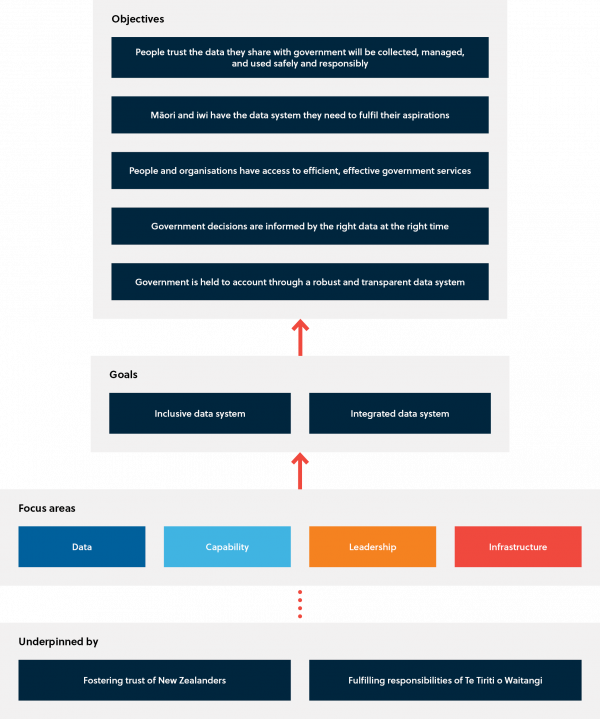
Fig 2. The relationship between the Objectives, Goals, Focus areas and underpinning concepts.
If you'd like more information, have a question, or want to provide feedback, email datalead@stats.govt.nz.
Content last reviewed 17 September 2021.